
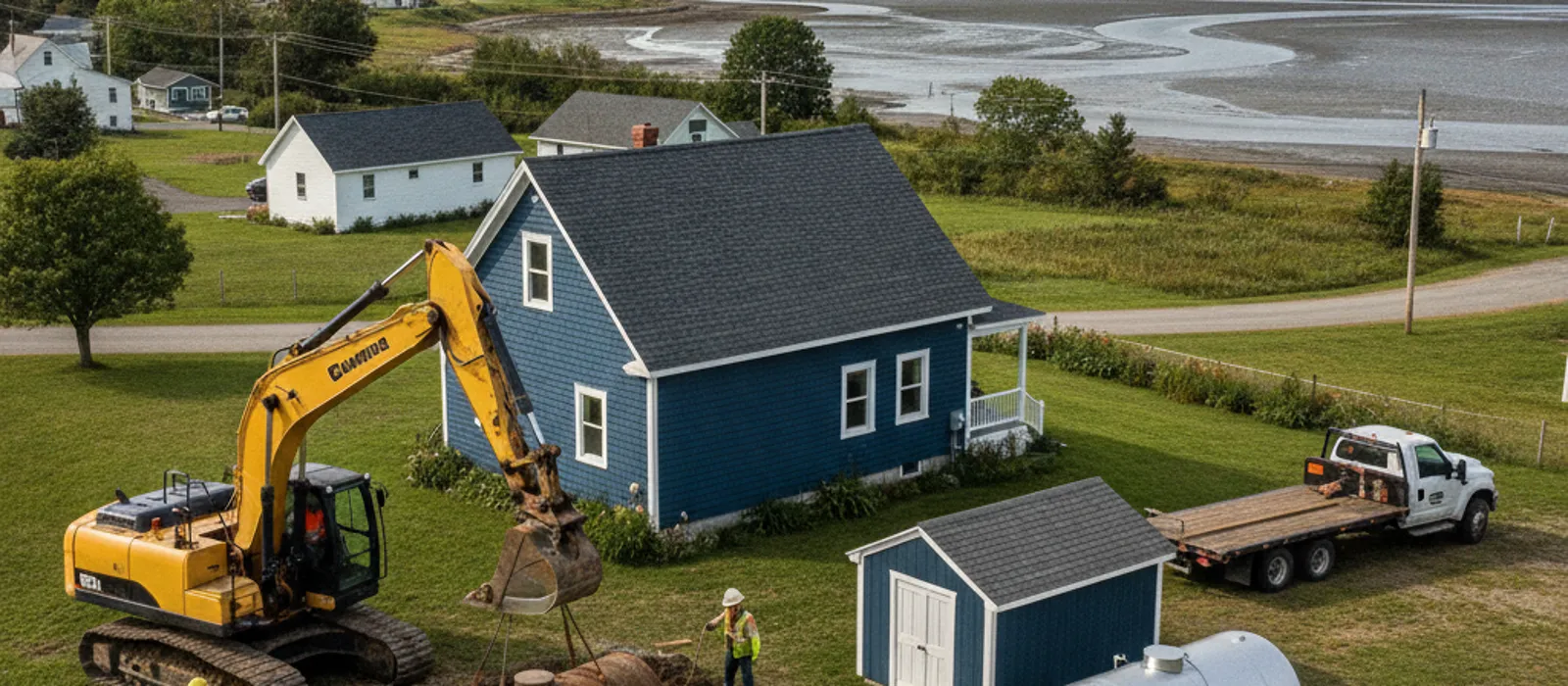
Two houses on the same street in Riverview. Two buried oil tanks, roughly the same size, installed around the same time. One owner paid $3,400 to have theirs removed. The other paid $14,200.
That gap is the whole story of buried oil tank removal cost in southeast New Brunswick. Pulling a steel tank out of the ground is the cheap part. What decides your final bill is everything around the tank: how deep it sits, what’s built over it, how high the water table is, and above all, whether any oil ever leaked into the soil.
If a home inspector, insurance company, or a rusty fill pipe in the lawn just told you there’s a tank under your property, here’s what removal actually costs in Moncton, Dieppe, Riverview, and the surrounding towns, and exactly what pushes the number up.
Buried Oil Tank Removal Cost in Greater Moncton: The Real Numbers
For a straightforward job, most homeowners in Greater Moncton pay between $2,000 and $4,000. That’s a tank in the front or side yard, buried a metre or so down, with room to get a small excavator in and no sign of a leak.
Here’s the full range of what we see across Westmorland, Albert, and Kent counties:
| Scenario | Typical cost (CAD) |
|---|---|
| Locate and scan only (confirm a tank exists) | $300 to $600 |
| Straightforward dig, good access, no leak | $2,000 to $4,000 |
| Deep tank, tight access, or high water table | $5,000 to $8,000 |
| Minor soil contamination found at removal | $8,000 to $15,000 |
| Significant leak needing full remediation | $15,000 to $30,000+ |
| Abandonment in place, where permitted | $1,500 to $3,500 |
Every one of those ranges assumes a licensed contractor doing the work properly: pumping out residual oil, cutting and lifting the tank, collecting soil samples, backfilling with clean material, and hauling the tank away for recycling. A quote well below these numbers usually means one of those steps is missing.
Marc in Dieppe is a good example of the simple end. He bought a 1960s bungalow last spring, spotted a capped pipe beside the foundation, and called us to scan the yard. We found a 900 litre tank under the flower bed, four feet down, dry as a bone inside. Total cost including the scan, removal, soil samples, and backfill: $4,100.
If you’ve found a suspicious pipe and want to know what you’re dealing with before anything else, call us at (506) 806-0900. The scan is quick, the estimate is free and in writing, and knowing beats guessing.
Why Buried Tanks Cost More Than Above-Ground Removals
A standard above-ground tank in a basement or beside the house comes out for $500 to $1,200 in most cases. So why does putting the same tank underground triple or quadruple the price to remove it?
Excavation is the obvious part. You need utility locates before anyone digs, an excavator on site, an operator who knows how to work around foundations and water lines, and clean fill to close the hole afterward. That alone is a full day of equipment and crew time.
The bigger reason is uncertainty. An above-ground tank shows you its condition. A buried steel tank has spent decades in wet, acidic soil where corrosion works from the outside in, and nobody knows what shape it’s in until it’s out of the ground. Contractors have to price in the possibility of finding holes, sludge, or stained soil.
Then there’s testing. Any responsible removal in New Brunswick includes soil sampling around and under the tank. If the samples come back clean, you get paperwork proving it, which matters enormously when you sell. If they don’t, you’ve caught a problem early instead of leaving it for a buyer’s inspector to find. Our buried oil tank removal service in Moncton includes sampling on every underground job for exactly that reason.
Six Factors That Drive an Underground Tank Removal Cost Up
When two quotes for the same neighbourhood come back thousands of dollars apart, one of these six factors is almost always the reason.
1. Depth and tank size. A 550 litre tank under a metre of soil is a half-day job. A 1,100 litre tank two metres down means a bigger hole, more spoil to manage, shoring considerations, and a lot more backfill. Deeper digs also raise the odds of hitting groundwater.
2. Access. If the excavator can drive straight to the spot, great. If the tank sits under a deck, a paved driveway, an addition, or in a fenced back yard on a tight Moncton lot, expect to pay for demolition, hand digging, or a smaller machine making slower progress. Restoring whatever was on top adds more.
3. The water table. This one surprises people. Along the Shediac and Cap-Pelé coast, and in low-lying parts of Salisbury and Memramcook, groundwater can sit just a few feet down. A hole that fills with water needs pumping, and wet excavation is slower, messier work.
Diane in Shediac ran into both problems at once. Her tank sat under a corner of the back deck, about 200 metres from the water, and the hole started filling before the crew reached the bottom of the tank. Between deck removal, dewatering, and rebuilding the deck section, her job landed at $7,200 instead of the $4,500 she’d hoped for. No leak, thankfully, so it ended there.
4. Contamination. The big one, covered in the next section. Even a small stained patch of soil changes the job completely.
5. Disposal distance and soil hauling. Clean tanks get cut up and recycled locally. Contaminated soil has to go to an approved facility, and trucking fees add up fast when you’re moving 20 or 30 tonnes.
6. Season. Frozen ground in January and February means slower digging and sometimes ground thawing equipment. If your situation isn’t urgent, booking between May and November usually gets you a better price and an easier dig.
What Happens to the Price if the Tank Leaked
Everything above assumes the soil samples come back clean. When they don’t, the removal becomes a remediation project, and the budget changes by an order of magnitude.
New Brunswick treats petroleum releases seriously. A confirmed leak generally needs to be reported to the Department of Environment and Local Government, and cleanup has to meet provincial standards before the file is closed. That means excavating contaminated soil until samples pass, sometimes installing monitoring wells, and documenting all of it.
Earl in Sackville went through this two winters ago. His buried tank had a pinhole leak that had likely been seeping for years. The removal itself was routine, but the crew pulled out dark, diesel-smelling soil from under one end of the tank. By the time the contaminated material was excavated, hauled away, and the samples passed, his total was $19,800.
The one piece of good news: catching it during a planned removal is far cheaper than catching it after oil reaches a basement, a well, or a neighbour’s property. The US EPA’s research on underground storage tanks shows why regulators everywhere push to get old single-wall steel tanks out of the ground: the longer they sit, the more likely they fail. We’ve broken down real cleanup numbers in our guide to oil spill cleanup cost. And check your policy wording before you assume insurance will help, because many policies exclude gradual seepage from old buried tanks.
If you ever smell oil near an old fill pipe or see sheen in a wet spot in the yard, stop there. Don’t dig, don’t investigate with a shovel, and don’t run a pump. Call our 24/7 emergency line at (506) 806-0900 and let a licensed crew assess it safely.
Removal vs Abandoning the Buried Tank in Place
Some homeowners ask about the cheaper-sounding option: leave the tank where it is, clean it out, and fill it with sand or gravel slurry. It’s called abandonment in place, and in some situations, like a tank partly under a house footing where excavation would risk the foundation, it’s the sensible call.
Done properly, abandonment runs $1,500 to $3,500. The tank gets pumped out, cleaned, cut open, inspected, filled with inert material, and documented.
But there’s a catch that costs people money later. An abandoned tank stays on your property’s record, and many buyers, lawyers, and lenders in the Moncton market treat it as an unresolved question. Soil under the tank usually can’t be fully sampled, so nobody can certify it never leaked. We’ve seen sales stall over exactly this. Our post on abandoning an oil tank in place walks through when it’s allowed and when it backfires.
If you’re planning to sell within the next decade, full removal with clean soil samples is almost always worth the difference in price. It closes the question permanently.
How to Keep Your Removal Quote Down
You can’t change where the tank sits, but you can control a few things that keep the bill closer to the bottom of the range.
Confirm before you commit. A locate and scan costs a few hundred dollars and tells you the tank’s size, position, and depth. Quotes based on a scan are firm. Quotes based on guesswork carry padding. If you’re not even sure a tank exists, our guide on how to find a buried oil tank covers the telltale signs.
Get the estimate in writing, itemized. It should list excavation, pumping, tank disposal, soil samples, and backfill, plus the per-tonne rate for contaminated soil if any is found. That last line matters most, because it’s where surprise bills come from.
Ask what happens if contamination shows up. A good contractor stops, shows you the soil, explains the numbers, and gets your go-ahead before the job changes scope. You should never learn about remediation from the invoice.
Clear the access yourself. Moving a shed, trimming hedges, or relocating a parked trailer before the crew arrives can shave real money off the job.
Don’t dig it yourself. An old tank can still hold a surprising amount of oil and sludge, and puncturing it with a rented mini excavator turns a $4,000 job into a $15,000 one. This is one of those projects where DIY has no cheap failure mode.
Think about what comes next. If the buried tank was still feeding your furnace, you’ll need a new above-ground tank before heating season. Bundling the removal with a modern double-wall installation through our oil tank replacement service in Moncton is usually cheaper than booking them separately, and it keeps you on one timeline.
Every buried tank job we quote starts with a free written estimate and a straight answer about what could change the number. Request yours here or call (506) 806-0900, and we’ll tell you exactly what’s under your lawn and what it’ll cost to deal with it.
Frequently Asked Questions
How much does buried oil tank removal cost in New Brunswick?
Most straightforward residential removals in Greater Moncton run $2,000 to $4,000, including excavation, tank disposal, soil samples, and backfill. Difficult access, deep tanks, or high groundwater can push that to $8,000. If the tank leaked, remediation can bring the total to $15,000 to $30,000 or more depending on how far the oil spread.
Does home insurance pay for removing a buried oil tank?
Almost never for the removal itself, since insurers treat that as property maintenance. Coverage for leak cleanup varies widely, and many policies exclude gradual seepage from old underground tanks entirely. In fact, most insurers in New Brunswick now require old buried tanks to be removed or decommissioned before they’ll issue or renew a policy.
Can I just leave the buried tank in the ground?
Sometimes, if it’s properly pumped out, cleaned, filled with inert material, and documented, which typically costs $1,500 to $3,500. It’s mainly used when excavation would threaten a foundation or other structure. The downside is that the tank stays on your property’s record and can complicate a future sale, because the soil beneath it was never fully tested.
How do I know if my property has a buried oil tank?
Look for a capped fill pipe or vent pipe near the foundation, unexplained copper lines entering the basement wall, or a rectangular depression in the lawn. Homes in the Moncton area built before the 1970s that had oil heat are the most likely candidates. A professional scan with a metal detector or ground-penetrating radar confirms it for a few hundred dollars, and it’s the first step we take on every buried tank call.