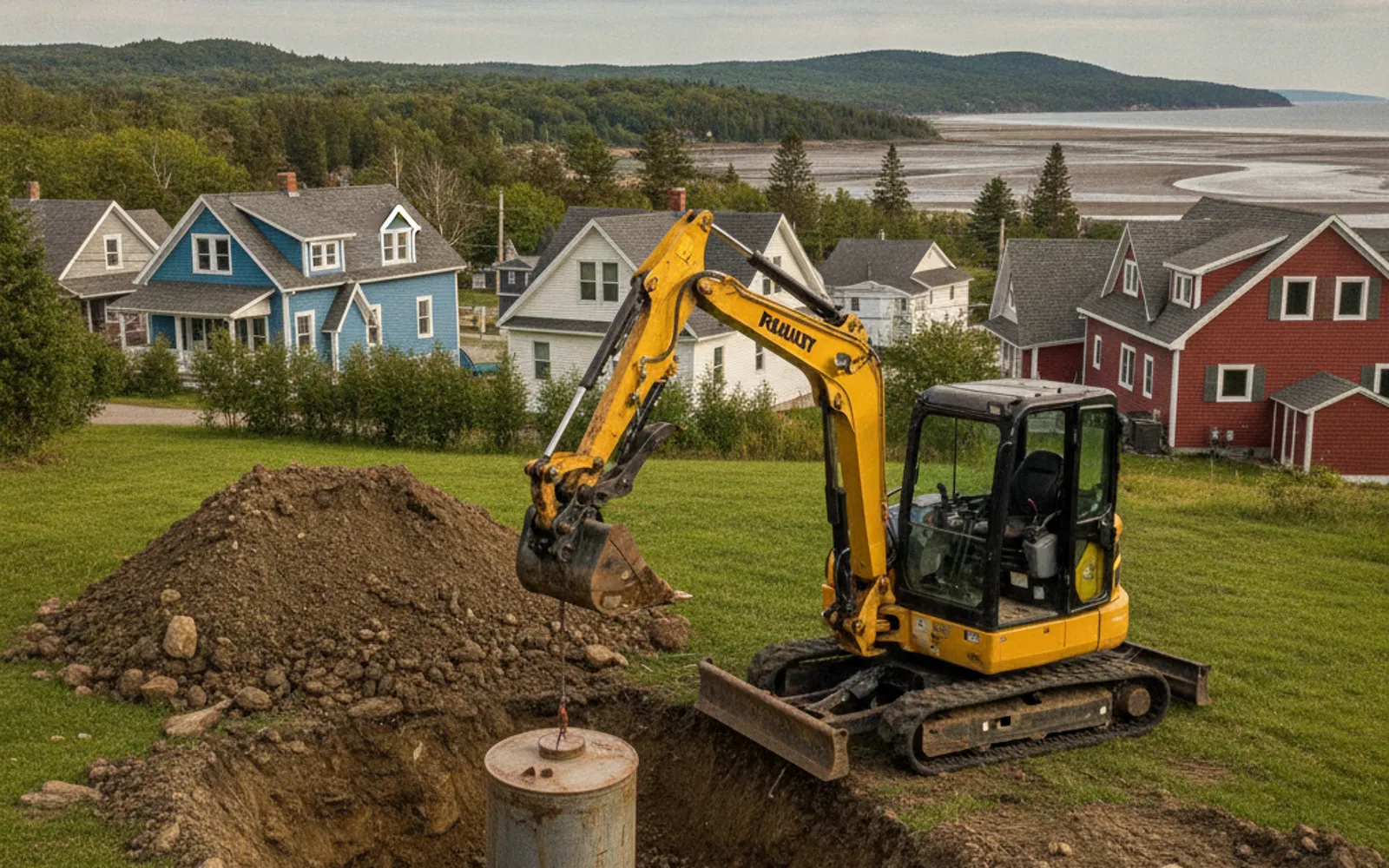
Old underground oil tanks can stall a home sale and spook insurers. We dig them out, test the soil and hand you the paperwork that proves the job was done right.
Hub City Tank Co handles buried oil tank removal across New Brunswick, from Moncton and Dieppe out to Shediac, Sackville and everywhere in between. Underground oil tanks were common on properties heated before the 1980s, and most homeowners only find out about them when a home inspector, insurance company or lender starts asking questions. If that's where you are right now, take a breath. This is a solvable problem, and we deal with it every week.
Our crew locates the tank, excavates it safely, pumps out any leftover oil, and tests the soil underneath before we backfill. If the ground is clean, you'll have documentation proving it. If it's not, we walk you through the cleanup step by step, including the required notification to the provincial environment department. Either way, you get a free written estimate before we put a shovel in the ground. Call (506) 806-0900 to get started.
We locate the tank, arrange utility locates, and dig it out with equipment sized for your lot. Tight yards and older neighbourhoods aren't a problem.
Once the tank is out, we sample the soil beneath and around it. You get lab-backed proof the ground is clean, or a clear picture of what needs fixing.
When contamination turns up, the provincial environment department has to be notified. We take care of that reporting so it's done properly and on time.
Closing dates don't wait. We prioritize removals tied to home sales and supply the documentation that buyers, lenders and insurers ask to see.
Buried tank work mixes excavation, fuel handling and environmental rules. Our crew carries the licence and insurance to do all of it by the book.
You'll know the price before we start, in writing. If soil conditions change the scope, we explain the numbers before any extra work happens.
Most buried oil tanks in Southeast New Brunswick went into the ground between the 1950s and the early 1980s. They're bare steel sitting in damp soil, and they corrode from the outside in, which means nobody can inspect them and nobody knows their condition. A tank can look fine from the fill pipe and still be leaking a litre a day into the ground under your lawn.
That slow leak is the real danger. Heating oil spreads through soil quietly, and by the time you smell it in a basement or a neighbour's well, the cleanup bill has grown from a few thousand dollars into a much bigger number. Insurers know this, which is why most of them refuse to cover homes with old or unknown underground tanks at all.
The fix is straightforward: get the tank out, test the soil, and keep the paperwork. If you still heat with oil, we can pair the dig with a new above-ground tank through our oil tank replacement service in Moncton. If your old tank sits in a basement or beside the house instead of underground, our standard oil tank removal service covers that.
Every job starts with a site visit and a free written estimate. From there, a typical buried tank removal follows the same basic path:
Most single-tank residential removals wrap up in one day on site. Lab results usually follow within a few business days, and that report is what your insurer, lender or buyer actually wants to see. We serve the whole region, including Dieppe, Riverview and Salisbury.
First, don't panic. Finding oil-stained soil under an old tank is common, and most cases are smaller than homeowners fear. A contained leak that stayed near the tank often cleans up for $2,000 to $5,000 CAD. Larger plumes that spread deeper or toward a foundation or watercourse can run $10,000 or more, and the price climbs mainly with how far the oil travelled.
New Brunswick requires that the provincial environment department be notified when petroleum contamination is found. We handle that notification and coordinate the remediation, so you're not left guessing what the province expects. Doing it properly also protects you later, because a documented cleanup is something you can hand to a future buyer with confidence.
Two more things worth knowing. Some homeowner policies help with cleanup costs and many exclude them, so it's worth a call to your broker before assuming either way. And the earlier a leak is caught, the cheaper it is, which is the best argument for dealing with a suspected tank now instead of next year. If you have oil actively surfacing or a strong smell indoors, use our 24/7 emergency oil tank line instead of waiting for a scheduled visit.
Most of our buried tank calls start with a real estate transaction. A home inspector spots a fill pipe or vent stub, the buyer's agent asks questions, and suddenly there's a condition on the sale. Lenders and insurers routinely refuse properties with unknown underground tanks, so an old tank in the ground can stall a closing even when both sides want the deal done.
If you're selling, the cleanest move is to remove the tank before you list, or as soon as it's discovered. A completed removal with clean soil results turns a deal-breaker into a one-page document. If you're buying, make removal and soil testing a condition of purchase, because once you own the property, you own whatever is in the ground under it.
We work these jobs on tight timelines across Greater Moncton and the surrounding communities, including Shediac, Memramcook and Sackville. Tell us your closing date and we'll build the schedule around it. For a sense of what replacing the heating side costs, see our oil tank replacement cost guide.
Most straightforward buried tank removals in the Greater Moncton area land between $2,000 and $4,000 CAD, depending on tank depth, size and access. If soil testing finds contamination, remediation typically adds $2,000 to $10,000 or more depending on how far the oil spread. You get a free written estimate up front, and we explain any changes before doing extra work.
There's no blanket law that forces removal, but in practice most sales can't close with an unknown buried tank in the ground. Lenders and insurers routinely refuse these properties, and buyer inspections flag the telltale fill and vent pipes. Spending $2,000 to $4,000 on removal with clean soil results almost always costs less than a collapsed sale or a renegotiated price.
Look for a capped fill pipe or vent pipe near the foundation, a copper line entering the basement wall, or records showing the home heated with oil before the 1980s. Homes built before about 1975 in older Moncton, Dieppe and Riverview neighbourhoods are the most common candidates. If you're not sure, we can locate the tank during a site visit before any digging starts.
A clean removal with no contamination doesn't become a government file, though you should keep the soil results for resale. If contamination is found, New Brunswick requires notification to the provincial environment department, and we handle that reporting as part of the job. Proper reporting protects you too, since a documented cleanup is proof the problem was fixed.
The dig itself is usually one day for a single residential tank, and soil lab results typically come back within 3 to 5 business days. If contamination needs cleanup, add anywhere from a few days to a few weeks depending on how far it spread. We can usually schedule within a week or two, and we move faster for real estate deadlines or active leaks on our 24/7 emergency line at (506) 806-0900.
Free written estimates. Emergency calls answered around the clock.