
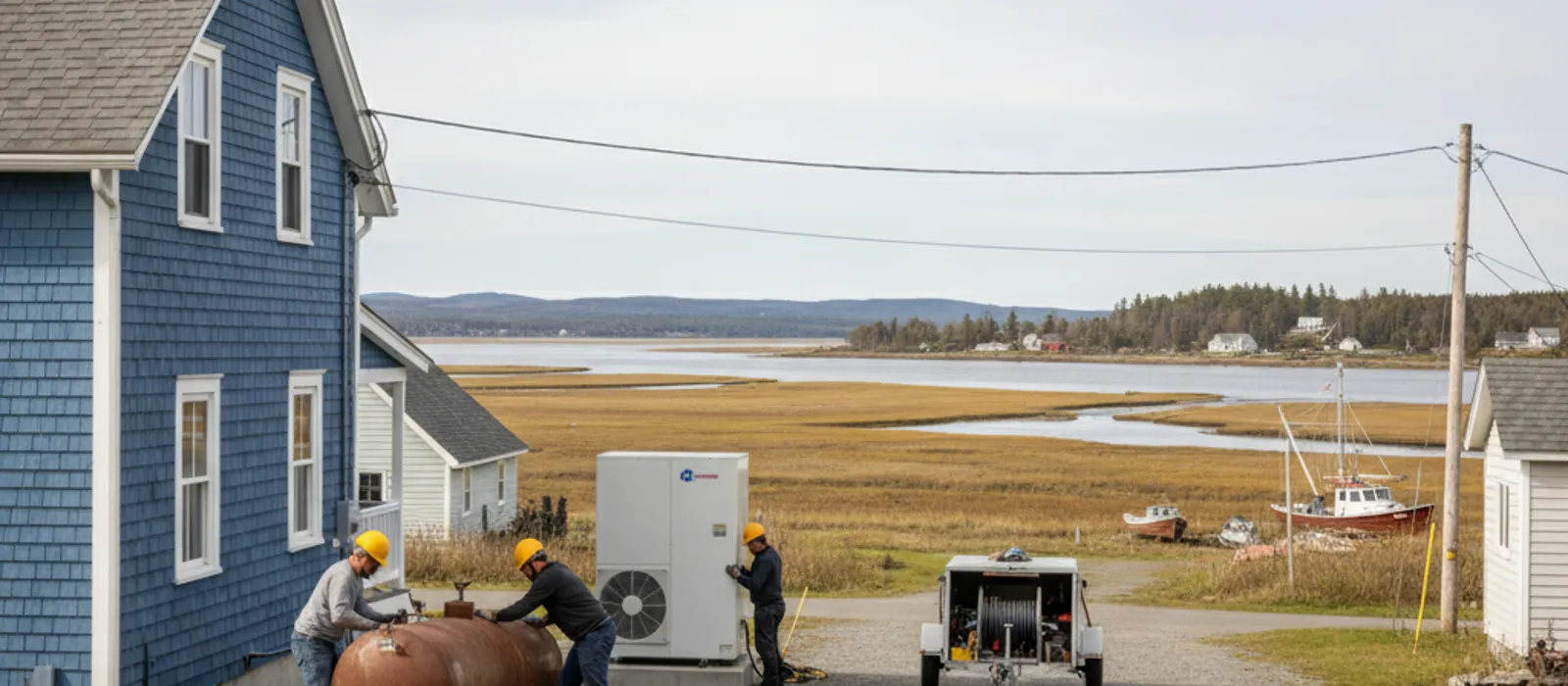
Plenty of Greater Moncton homeowners spent more than $3,000 on heating oil last winter. That number, more than any flyer or sales pitch, is why the oil to heat pump conversion question comes up at so many kitchen tables in Moncton, Dieppe, and Riverview right now.
Here’s something you might not expect. We’re a tank company. We replace and remove oil tanks for a living, so you’d think we’d try to talk you out of a heat pump. We won’t. We see the tail end of every oil to heat pump conversion in the Moncton area anyway, because somebody still has to deal with the tank, the leftover oil, and the furnace that’s now a 400 pound paperweight. So here’s the honest, start to finish picture: what it costs, how it works, and the one step almost everyone forgets.
Why Half of Greater Moncton Is Thinking About This Right Now
A few things are pushing people in the same direction at once.
Oil prices have been jumpy for years. When furnace oil sits anywhere between $1.10 and $1.60 a litre and a typical bungalow burns 2,000 to 2,500 litres a winter, your annual heating bill can swing by a thousand dollars for reasons that have nothing to do with you.
Insurance companies are getting stricter. If your tank is past 15 or 20 years old, there’s a decent chance you’ve already had the letter: replace the tank or lose your coverage. Suddenly you’re not comparing “keep oil” against “switch to a heat pump.” You’re comparing “spend $2,500 to $3,500 on a new tank” against “put that money toward getting off oil entirely.”
And the grant money is real. Federal and provincial programs have made this the cheapest window in years to switch, especially for households that qualify for income tested funding. We’ll get into the details further down.
None of that means a heat pump is automatically right for your house. It means the question deserves real numbers instead of guesswork. If part of your decision is what to do with an aging tank, request a free written estimate or call us at (506) 806-0900. We’ll give you a straight answer on the tank side either way, whether you’re replacing it or getting rid of it.
What an Oil to Heat Pump Conversion in Moncton Actually Costs
The honest answer is a range, because “conversion” can mean two very different projects.
A partial conversion means adding one or more ductless mini split heads while keeping the oil furnace as backup. A full conversion means a cold climate heat pump sized to carry the whole house, the oil furnace decommissioned, and the tank removed.
Here’s what homeowners in our area typically pay before any rebates:
| Item | Typical Cost (CAD) |
|---|---|
| Ductless mini split, one head, installed | $4,000 to $5,500 |
| Multi zone mini split, two or three heads | $8,000 to $14,000 |
| Central ducted cold climate heat pump | $12,000 to $18,000 |
| Electrical panel upgrade, if needed | $2,500 to $4,500 |
| Oil furnace decommissioning and removal | $500 to $1,000 |
| Above ground oil tank removal | $300 to $800 |
| Buried oil tank removal | $2,500 to $10,000 or more |
Diane in Riverview went the partial route two winters ago. She put $8,600 into a two head mini split and kept her oil furnace for the coldest stretches. Her oil use dropped from about 2,300 litres a year to under 900. At recent prices that’s roughly $1,800 a year staying in her pocket, and the mini splits gave her air conditioning in July as a bonus.
A full conversion costs more up front but ends the oil bill completely. The catch is the extras people don’t budget for: the panel upgrade if your electrical service is older, and the tank work at the end. A surprising number of quotes from HVAC companies stop at the heat pump itself and leave the tank as “somebody else’s problem.” That somebody is usually us, and it’s better to price it in from day one.
The Oil to Heat Pump Conversion Process, Step by Step
A proper conversion follows a predictable path. Here’s the version with no surprises.
1. Heat load assessment. A good installer calculates what your house actually loses on a cold night, room by room. If a contractor quotes you a system over the phone without seeing the house, keep shopping.
2. Electrical check. Cold climate heat pumps draw serious power. Homes with 100 amp service, common in older Moncton neighbourhoods and in a lot of Memramcook and Salisbury farmhouses, often need a 200 amp upgrade before anything else happens.
3. Heat pump installation. For a ducted system, the new air handler usually goes where the oil furnace sat. For mini splits, it’s a day or two of mounting heads and running lines. Either way, the HVAC side typically wraps up inside a week.
4. Furnace decommissioning. The oil furnace gets disconnected, drained, and hauled out. The chimney or flue may need capping so you’re not pumping warm air out of an open hole all winter.
5. Leftover oil. Whatever’s in the tank has to be pumped out and handled properly. Some fuel companies will buy back clean oil at a reduced rate. Sludgy oil from the bottom of an old tank is a disposal item, not a refund.
6. Tank removal. The tank itself gets drained, disconnected, removed, and disposed of according to New Brunswick rules. This is licensed work, not a weekend project, because one dropped or tipped tank can turn into a spill that costs more than the entire conversion.
Steps 1 through 4 belong to your HVAC contractor and electrician. Steps 5 and 6 are where a tank company earns its keep.
Full Switch or Hybrid: Should You Keep the Oil?
Modern cold climate heat pumps hold their rated output far below freezing, and the better units keep producing heat at minus 25 or lower. Natural Resources Canada’s guide to heating with a heat pump is worth a read if you want the engineering version.
Still, plenty of local homeowners choose the hybrid route, and it’s not paranoia. It’s math and comfort.
A hybrid setup lets the heat pump carry 80 to 90 percent of the season while the oil furnace handles the deep freeze in January and February, when heat pumps work hardest and electricity use peaks. It also means a power outage with a generator, or an ice storm week, doesn’t leave you scrambling. We wrote a full comparison in our oil heat versus heat pump cost breakdown if you want to see the seasonal numbers side by side.
The hybrid route has one catch: your tank still has to be insurable. Gérald in Memramcook learned that the hard way. He’d budgeted $9,000 for mini splits and planned to keep his oil furnace as backup, then his insurer flagged his 26 year old tank during renewal. Keeping the hybrid plan meant a new tank at $3,100 on top of the heat pump money. He did both, and his total oil use is now about 600 litres a year, but the tank was not an optional line item. If you’re keeping any oil in the picture, check how old your tank is before you build the budget, and price a tank replacement into the plan if it’s past 15 years.
If you’re going fully electric, the calculation flips. There’s no reason to keep an aging tank around, and a few good reasons not to.
The Step Everyone Forgets: Dealing With the Old Tank
Here’s the pattern we see every spring. The heat pump went in over the winter, it worked beautifully, and now there’s a tank in the basement with 400 litres of oil in it that nobody has a plan for.
An idle oil tank isn’t harmless. It keeps rusting from the inside whether you burn oil or not, condensation builds in a tank that’s no longer being refilled, and a slow leak from a forgotten tank can cost tens of thousands in cleanup. Your insurer may also keep charging you for it, or ask pointed questions at renewal time. And when you eventually sell, a dead tank in the basement is a red flag that buyers’ home inspectors love to write up.
Marc and Lise Cormier in Shediac did it right. After their full conversion, a $16,800 ducted system before rebates, they had the leftover 300 litres pumped out, got a partial credit from their fuel supplier, and paid $650 to have the empty 910 litre tank removed and documented. That paperwork mattered: their insurer dropped the oil surcharge, and when they listed the house two years later, the file answered every question before it was asked.
Above ground tank removal is usually a few hundred dollars and a couple of hours. Buried tanks are a different story, with excavation and soil checks involved, which is why they run $2,500 and up. Our oil tank removal cost guide breaks down what drives the price in either case.
One safety note. Never cut up, drain, or move a tank yourself. Even an “empty” tank holds residual oil and vapour, and one slip means a contaminated basement floor or worse. This is exactly the point where DIY should stop and a licensed crew should take over. Our oil tank removal service covers Moncton and everywhere from Sackville to Shediac, and the estimate is free and in writing. Call (506) 806-0900 and we’ll tell you exactly what your removal would cost.
Grants and Rebates for New Brunswick Homeowners
This is where the numbers can change dramatically, especially for oil heated homes specifically.
The federal Oil to Heat Pump Affordability program has offered up to $10,000 in upfront funding for income eligible households switching from oil to a cold climate heat pump. On top of that, NB Power has run heat pump incentives for New Brunswick homes, with the richest amounts aimed at lower income households.
Two cautions from watching neighbours go through this. First, program rules and funding windows change, sometimes mid season, so confirm the current details on the official pages before you sign a contract. Second, most programs require you to apply and be approved before the installation starts. Doing the work first and asking after is the most expensive mistake in this whole process.
The paperwork usually asks you to prove your home is heated with oil, which means delivery receipts or photos of the tank and furnace. Keep those handy. And if the program requires the oil system to be fully decommissioned, the tank removal documentation we mentioned above becomes part of your claim, not just a nice to have. We keep a current rundown in our guide to oil to heat pump grants in New Brunswick.
Put it all together and a $15,000 full conversion can land closer to $5,000 out of pocket for a qualifying household. That’s a very different decision than the sticker price suggests.
Thinking it through for your own place? Whether you’re converting fully, going hybrid with a new tank, or just want the old tank gone, get in touch for a free written estimate. We’ll give you the tank side numbers in writing so you can plan the whole project with real figures.
Frequently Asked Questions
How much does an oil to heat pump conversion cost in Moncton?
Most partial conversions with mini splits run $4,000 to $14,000 depending on how many heads you need. A full conversion with a central cold climate heat pump, furnace removal, and tank removal typically lands between $14,000 and $22,000 before rebates. Income eligible households can knock $10,000 or more off that through federal and provincial programs.
Can a heat pump handle a Moncton winter on its own?
A properly sized cold climate heat pump can, yes. The better units keep producing usable heat at minus 25 and below, which covers almost every night we get in Southeast New Brunswick. The key words are properly sized, which is why a room by room heat load calculation matters more than the brand name on the unit.
Do I have to remove my oil tank after converting?
There’s no law forcing you to remove it immediately, but leaving it is a bad bet. An idle tank keeps corroding, your insurer may keep charging for it or refuse to renew, and some grant programs require full decommissioning anyway. Removal of an above ground tank usually costs $300 to $800, which is cheap insurance against a leak cleanup that can run into five figures.
How long does the whole conversion take?
The heat pump installation itself is usually one to three days, and a panel upgrade adds another day. Furnace decommissioning and tank removal typically take half a day once scheduled. From first quote to final tank pickup, most homeowners are done inside three to six weeks, with grant approval usually the longest wait in the chain.