
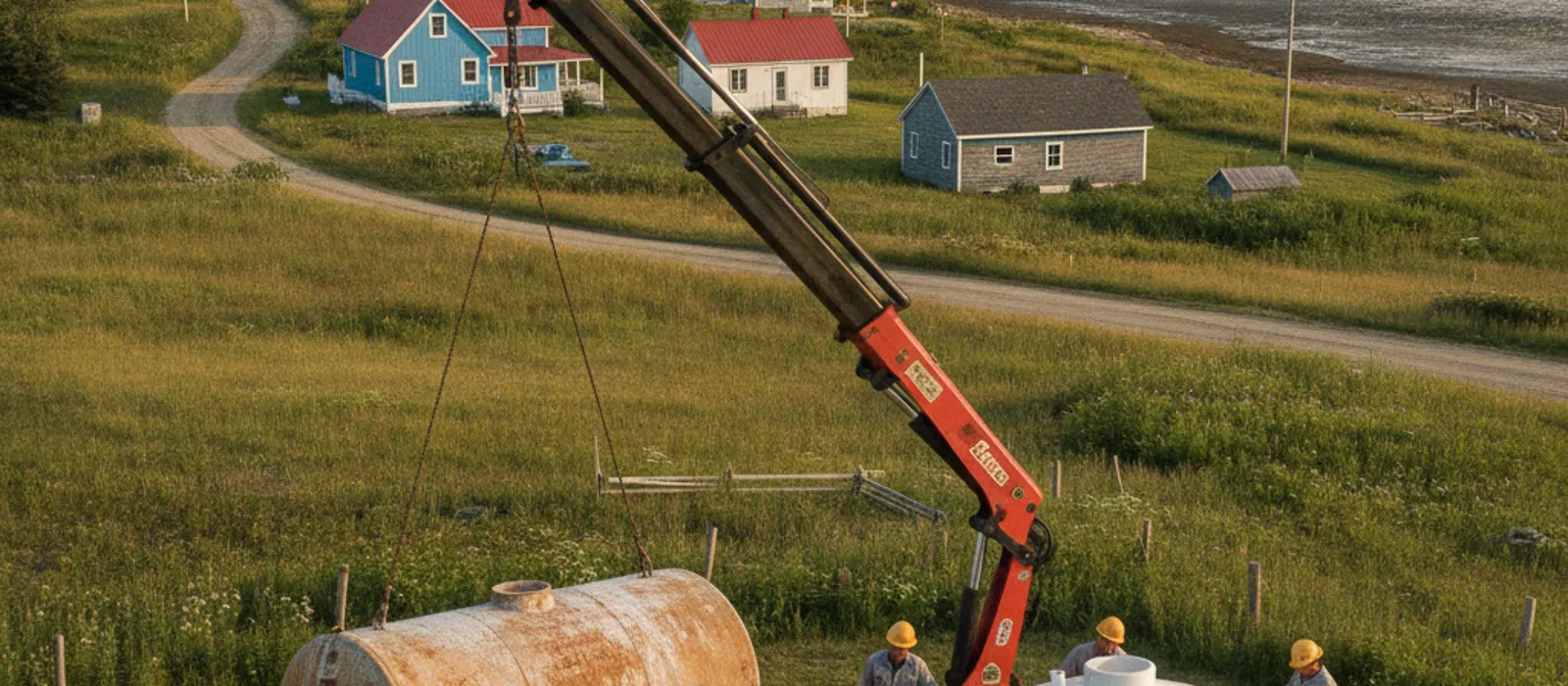
Two steel oil tanks came off the same truck in the spring of 2012. One went to a backyard in Salisbury, a good 40 kilometres from open water. The other went to a winterized cottage in Pointe-du-Chêne, a five minute walk from Parlee Beach. The Salisbury tank is still holding oil today. The coastal one started weeping through a pinhole in year thirteen. Same model, same oil, same winters. The difference was salt air oil tank corrosion, and if you live anywhere along the Northumberland Strait, it’s quietly working on your tank right now.
This isn’t a reason to panic. It’s a reason to understand what’s happening to your tank, check it a couple of times a year, and plan the replacement on your schedule instead of the tank’s. Here’s how salt air attacks steel, how much faster coastal tanks fail, and what it actually costs to stay ahead of it.
What Salt Air Actually Does to a Steel Oil Tank
Rust needs three things: iron, oxygen, and moisture. Every outdoor tank in New Brunswick gets plenty of all three. What salt adds is speed.
Sea spray and onshore wind carry tiny salt particles that settle on everything within a few kilometres of the water. You’ve seen the results on cars in Shediac, Cap-Pelé, and along the Scoudouc River. Salt is hygroscopic, which means it pulls moisture out of the air and holds it against the steel. So instead of drying off after a rain, a coastal tank stays damp longer, sometimes all day.
Worse, salt water is an electrolyte. It turns that damp film into a weak battery that strips electrons off the steel far faster than fresh water would. Corrosion engineers have measured this for decades. The U.S. Federal Highway Administration’s national corrosion study pegged the cost of corrosion at hundreds of billions of dollars a year, with marine and coastal environments among the most aggressive settings for bare steel. You can read the summary at fhwa.dot.gov.
Your tank fights back with paint and, on newer models, powder coating. But every scratch from a shovel, every chip from flying ice, every spot where the fill gauge or legs meet the shell becomes a bare steel target. On the coast, those small wounds never really dry out.
And here’s the part most homeowners miss: the outside attack is only half the story. Condensation forms inside the tank too, and water settles to the bottom where sludge hides it. A coastal tank can be rusting from both directions at once, which is why some tanks fail from the inside out while the paint still looks decent. We covered the inside-out failure pattern in our guide to rust on your oil tank.
If your tank is near the water and past its tenth birthday, it’s worth a professional look before another winter. Call Hub City Tank Co at (506) 806-0900 for a free written estimate. No pressure, just a straight answer about how much life your tank has left.
How Much Faster Do Coastal Tanks Rust?
There’s no single number, because exposure varies house to house. A tank tucked behind a garage in Shediac town sees less spray than one facing the bay in Pointe-du-Chêne. But the pattern we see across Southeast New Brunswick is consistent enough to plan around.
An inland steel tank in Moncton, Salisbury, or Riverview commonly reaches 15 to 20 years before insurers and inspectors start raising flags. Within a few kilometres of salt water, that window shrinks. Tanks with direct exposure to onshore wind often show serious external pitting by year 10 to 12, and we’ve replaced coastal tanks that failed in under 10.
Here’s a rough comparison based on what we see in the field:
| Situation | Typical useful life | Typical replacement cost (CAD) |
|---|---|---|
| Inland single-wall steel (Moncton, Salisbury) | 15 to 20 years | $2,600 to $3,600 |
| Coastal steel, sheltered spot (Shediac town) | 12 to 16 years | $2,600 to $3,600 |
| Coastal steel, exposed to onshore wind (Pointe-du-Chêne, Cap-Pelé) | 8 to 14 years | $2,800 to $3,800 |
| Coastal fibreglass or composite double-wall | 25 to 30 years, long warranty | $3,500 to $5,000 |
Two things jump out of that table. First, location can cost you five to ten years of tank life. Second, the premium for a fibreglass or composite tank is often $1,000 to $1,500, but it can roughly double your service life on the coast.
One more wrinkle: insurance. Many insurers in New Brunswick want steel tanks replaced by age 15, sometimes younger for outdoor coastal installs. If your renewal letter asks for the tank’s age and you’re not sure, dig out the data plate and check before they check for you.
Three Local Tanks That Lost the Fight With Salt
Names and details below are drawn from the kinds of calls we take every season along the Strait. The dollar figures are real-world numbers for this region.
Marcel, Pointe-du-Chêne. Marcel’s tank sat on the seaward side of his place, catching every onshore blow. The paint looked tired but intact, so he wasn’t worried. During a routine fill, his delivery driver spotted a rust blister low on the end cap and refused to fill past half. We found pitting deep enough to flag the tank as a leak risk. Marcel replaced it for $3,150 all in. Two streets over, a neighbour with the same vintage tank waited a year too long, lost a few hundred litres into the soil, and faced a cleanup bill north of $14,000 that insurance only partly covered.
Heather, Sackville. Heather was buying an older home near the marsh. The outdoor tank had a fresh coat of paint and looked fine in the listing photos. Her home inspector scratched at a seam weld and found scale flaking off underneath, which is a classic sign the paint was hiding active corrosion. Her insurer wouldn’t bind the policy until the tank was replaced. She used that to negotiate $3,000 off the purchase price, then had us install a new tank for $2,950. The paint job had been covering a problem, not fixing one.
Gilles, Shediac. Gilles noticed a damp patch under his tank’s outlet fitting in the fall but figured it was rain. By February it was clearly oil. The good news: he called before it got worse, we swapped the tank in a day for $3,300, and the spill stayed small enough to remediate for about $2,400. The lesson he’d want you to hear is simple. A wet spot under a coastal tank is guilty until proven innocent. If you see one, our article on what a wet spot under your oil tank means walks through it, and our emergency line answers 24/7.
Salt Air Oil Tank Corrosion: Warning Signs You Can Check This Month
You don’t need tools or training to catch most problems early. Grab a flashlight and give your tank ten minutes. Here’s what matters most on a coastal tank.
Check the seaward side first. Corrosion is rarely even. The face of the tank that catches onshore wind and spray usually goes first, and it’s often the side nobody looks at.
Look low, not high. Moisture runs down and sits at the bottom of the shell, along the bottom weld seam, and where the legs meet the tank. Pinholes almost always start in the lower third. Blistered or bubbled paint down there means rust is pushing up from underneath.
Scratch test, gently. If a spot looks rusty, press it with a gloved thumb. Flaking scale, orange dust, or any give in the metal means the wall is thinning. Don’t poke suspect spots with a screwdriver. People have punched holes in tanks doing that, and then a slow problem becomes an emergency in your yard.
Check the legs and stand. Salt attacks the legs and the stand as fast as the tank. A leaning tank stresses the oil line and can shear a fitting. If your tank isn’t sitting level and solid, treat that as urgent.
Smell around the fill and vent. A persistent oil smell outside, or oil sheen on puddles near the tank, means oil is getting out somewhere. Stop there and call a professional. This is past the DIY line.
Make this a twice-a-year habit, spring and fall. Our full oil tank inspection checklist covers the complete walk-around, including the gauge, vent whistle, and oil line.
If anything on that list looks off, don’t wait for the tank to make the decision for you. Request a free written estimate and we’ll tell you honestly whether it’s a watch-it situation or a replace-it situation.
How to Slow the Rust Down, and When to Stop Fighting It
You can’t stop salt air, but you can take away some of its advantages. These steps genuinely buy time on a coastal tank.
Break the spray line. A simple windbreak, fence section, or lattice screen between the tank and the prevailing onshore wind cuts the salt load dramatically. Leave enough room to walk fully around the tank for inspections and fills.
Keep it off the ground and clear underneath. A proper concrete pad and sound legs keep the bottom of the tank dry. Never let leaves, snow, or firewood pile against the shell. Trapped debris holds salty moisture against the steel around the clock.
Rinse it once in a while. A gentle freshwater rinse in spring and fall washes accumulated salt off the shell, the same logic as washing your car after a winter of road salt. Skip the pressure washer, which can strip coating and drive water into fittings.
Touch up chips promptly. Small paint chips are where coastal corrosion starts. Clean the spot, let it dry, and touch it up with rust-inhibiting paint made for metal. Painting over active rust, like Heather’s seller did, just hides the problem.
Deal with inside water. Coastal humidity means more condensation inside the tank. Keeping the tank full through summer reduces the air space where condensation forms, and a fuel technician can test for water at the bottom.
Now the honest part. Maintenance slows corrosion, but it can’t reverse thinning steel. Once a tank shows deep pitting, seam rust, blistering, or any weeping, no coating or rinse routine will make it safe. At that point the smart money goes to replacement, ideally a fibreglass or double-wall composite tank that shrugs off salt air for decades. Our oil tank replacement service in Moncton covers the whole region, and if you’re on the coast, our Shediac oil tank service page has details specific to your area. For context on what tank problems can cost when they’re ignored, the U.S. EPA’s storage tank program at epa.gov/ust documents how expensive fuel releases become once oil reaches soil or groundwater.
What a Coastal Tank Replacement Actually Costs
For most homes in Shediac, Pointe-du-Chêne, Cocagne, and along the Strait, a straightforward outdoor tank replacement runs $2,800 to $3,800 installed. That typically includes the new tank, removal and disposal of the old one, new oil line and fittings as needed, and a proper stand or pad check.
Upgrading to a fibreglass or composite double-wall tank usually lands between $3,500 and $5,000. On the coast, we think that premium earns its keep. You get a tank that salt air can’t rust, warranties that often run 25 years or more, and an easier conversation with your insurance company at every renewal.
Compare either number to the downside. A leak that reaches soil starts around $5,000 to $10,000 to clean up, and coastal properties with high water tables can climb far past that. Marcel’s neighbour would tell you the $3,000 tank was the bargain of the decade.
Every job starts with a free written estimate, and we’re licensed and insured. If your tank is coastal and double digits in age, let’s look at it before winter. Call (506) 806-0900 or book your free estimate online. If you’ve got oil on the ground right now, use our 24/7 emergency line instead and we’ll walk you through the first steps on the phone.
Frequently Asked Questions
How much faster does salt air corrode an oil tank?
Field experience along the Northumberland Strait suggests coastal steel tanks lose roughly a third to a half of their expected life compared to inland tanks. An inland tank that might serve 15 to 20 years often shows serious pitting by year 10 to 12 near the water. Exposure matters a lot, so a sheltered tank in Shediac town will outlast an identical tank facing the bay.
Can I just paint my tank to protect it from salt air?
Touching up chips on sound steel helps, and it’s worth doing every spring. But paint over active rust traps moisture against the metal and hides the damage from you and your inspector. If scale flakes off when you rub a spot, the tank needs a professional assessment, not a paint job.
Is a fibreglass tank worth the extra cost near the ocean?
In most coastal cases, yes. The upgrade typically costs $1,000 to $1,500 more than steel but resists salt air corrosion completely on the shell, often carries a warranty of 25 years or more, and tends to satisfy insurers for longer. If you plan to stay in the home more than a few years, it’s usually the cheaper option per year of service.
What should I do if my coastal tank is already leaking?
Stop adding oil, keep ignition sources away, and don’t try to patch the tank yourself. Put a container under an active drip if it’s safe to do so, then call a professional right away. Our emergency line at (506) 806-0900 answers 24/7, and small contained leaks handled quickly cost a fraction of what a soil cleanup does.