
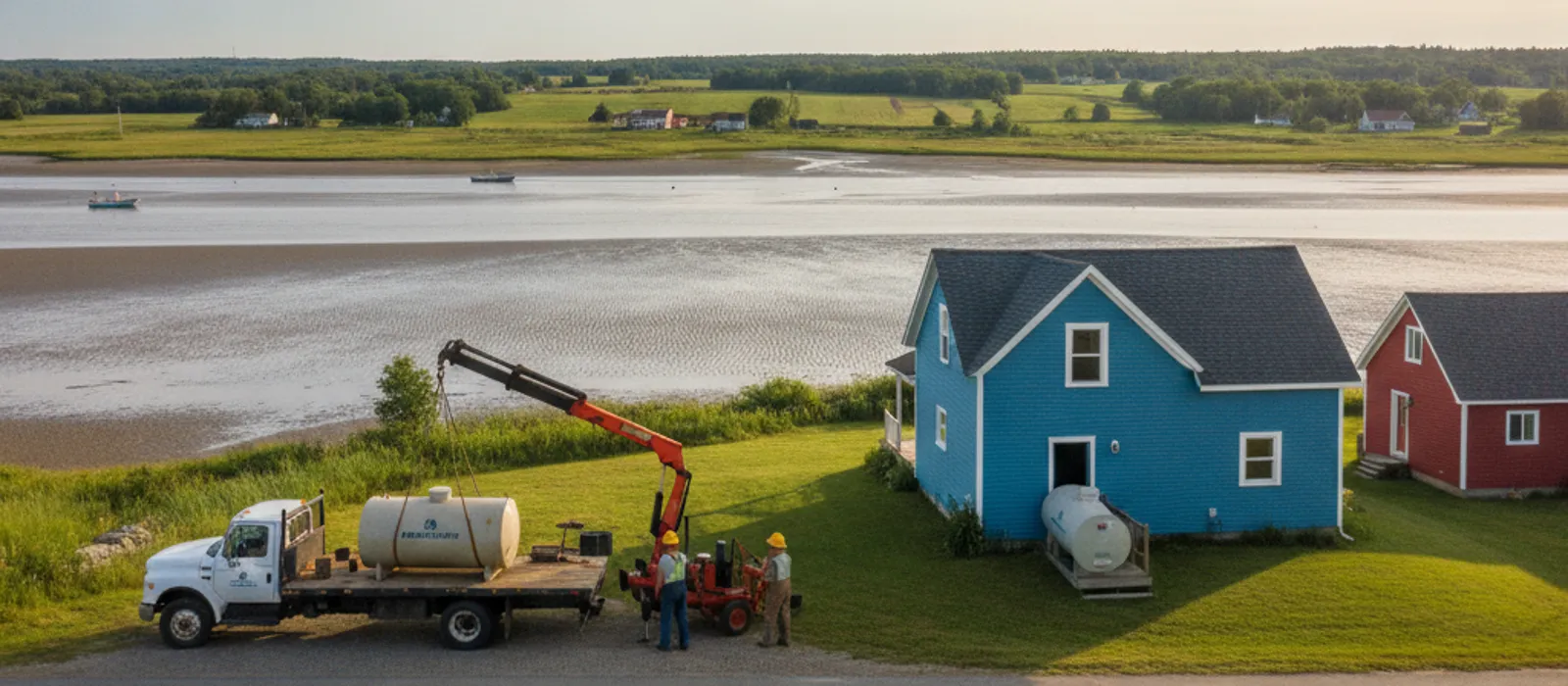
The insurance renewal letter shows up, it says your oil tank has to go, and suddenly you’re staring down a question you’ve never once thought about. Should the new tank sit in the basement, or outside against the wall?
We hear it every week. The indoor vs outdoor oil tank decision matters more here in New Brunswick than in most of Canada. Our freeze-thaw winters, heavy wet snow, and salt air near the Northumberland Strait are hard on outdoor tanks. On the other hand, plenty of Greater Moncton basements are tight, damp, or packed to the rafters, and not everyone wants 900 litres of furnace oil sharing space with the deep freeze.
Hub City Tank Co installs both setups across Moncton, Dieppe, Riverview, and the surrounding counties every week. Here’s the straight goods on cost, lifespan, and which location actually suits your house.
Why the Indoor vs Outdoor Oil Tank Question Matters More in NB
Start with the weather. An outdoor tank in Moncton takes everything winter can throw at it. Rain, ice storms, snow sliding off the roof, and dozens of freeze-thaw cycles between November and April. The tank shell, the legs, the fittings, and the pad underneath all get worked over year after year.
Then there’s condensation, which is the quiet killer. When an outdoor tank swings from minus 20 at night to plus 5 in an afternoon thaw, moisture condenses on the inside walls of the tank. That water sinks below the oil, sits on the bottom, and rusts the tank from the inside out. That’s why so many tanks that look fine on the outside fail anyway. An indoor tank living at a steady basement temperature barely deals with this at all.
Coastal homes have it even worse. If you’re in Shediac, Pointe-du-Chene, or anywhere the sea breeze reaches, salt spray speeds up exterior rust in a way inland homeowners never see. We wrote about that in detail in our post on salt air and oil tank corrosion.
And finally, cold snaps. Furnace oil doesn’t freeze solid, but in a deep freeze it can thicken and gel in an outdoor tank or an exposed line, starving your furnace on the coldest night of the year. Indoor tanks simply don’t have that problem.
None of this means outdoor tanks are a mistake. It means location is a bigger deal here than the brochures suggest. If you’d rather talk it through with someone who installs these for a living, call Hub City Tank Co at (506) 806-0900. The written estimate is free, and we’ll tell you honestly which setup fits your house.
The Case for an Indoor Oil Tank
If your basement has the room, indoors is usually the better long-term home for a tank in our climate.
The biggest win is lifespan. A tank that might give you 10 to 15 years outside can run 20 to 25 years in a dry basement, because it’s protected from weather on the outside and condensation on the inside. Over the life of a house, that can mean buying one tank instead of two.
Indoor tanks also make winter simpler. No gelled fuel lines, no shovelling a path for the delivery driver to fight through, no chunk of ice off the roof denting your tank shell. Insurance companies tend to like them too. Many insurers allow indoor tanks to stay in service longer than outdoor ones before demanding replacement.
There are trade-offs. An indoor tank takes up real basement space, roughly the footprint of a chest freezer. Every litre of oil has to come in through a fill pipe and vent, so the plumbing has to be done right. And if an indoor tank ever does leak, the cleanup happens inside your home, which is exactly as miserable and expensive as it sounds. That’s why we only install tanks with proper drip protection, and why any oil smell in the basement deserves attention the same week you notice it.
Marc in Riverview learned how the math works last fall. His insurer gave him 30 days to replace a 14-year-old outdoor steel tank or lose coverage. The tank looked fine from the driveway, but at that age outside, no insurer wanted it on the books. We removed it and installed a fibreglass tank in his basement for $3,600, including transferring the 300 litres of oil he’d just paid for. The new tank should outlast his mortgage, and his renewal went through without another word.
The Case for an Outdoor Oil Tank
Outdoor tanks are the right call for a lot of homes around here, and it’s usually about the basement.
Some houses just don’t have the space. Low ceilings, tight stairwells, finished rec rooms, mini homes with no basement at all. Others have damp foundations where an indoor steel tank would rust nearly as fast as one outside. In those cases, a good outdoor tank on a proper pad is the honest answer, not a consolation prize.
Outdoor installs are also simpler and usually a few hundred dollars cheaper. The delivery driver can reach the fill easily, and when the tank eventually needs replacing, nobody has to wrestle 250 kilograms of steel up a staircase. If a leak ever happens, the oil ends up in the ground outside instead of across your basement floor. To be clear, an outdoor spill is still a serious and costly problem for your soil and your neighbours’ wells, but it won’t soak your rec room and everything stored in it.
The trade-off is a shorter life and more babysitting. Outdoor tanks need snow cleared off them, ice kept away from the fittings, and stable legs that aren’t slowly sinking into soft ground. Our guide on protecting your oil tank from snow and ice covers the winter routine in ten minutes a month.
Colette in Salisbury went the opposite direction from Marc, and it was the right move for her. Her 20-year-old basement tank left a faint oil smell she could never quite shake, and her basement stays damp most of the spring. We removed the old tank, cleaned up the minor weeping that caused the smell, and set a double-wall tank outside on a new pad. All in, $3,900 including disposal of the old tank. The smell is gone and she got a corner of her basement back.
Indoor vs Outdoor Oil Tank Costs: Side by Side
Here’s how the two options typically compare for homes in Greater Moncton. Prices are in Canadian dollars, installed, and assume a standard 910 litre residential tank.
| Factor | Indoor tank | Outdoor tank |
|---|---|---|
| Typical installed cost | $3,400 to $5,500 | $3,000 to $4,800 |
| Typical lifespan | 20 to 25 years | 10 to 15 years |
| Weather and snow exposure | None | Constant |
| Internal condensation risk | Low | Moderate to high |
| Fuel gelling in cold snaps | Very rare | Possible if untreated |
| Basement space required | Yes | No |
| Where a leak ends up | Inside the home | Soil and groundwater |
| Typical insurer age limits | More generous | Stricter |
A few notes on those numbers. The price spread inside each column mostly comes down to the tank you choose. A basic single-wall steel tank sits at the low end, while a fibreglass or double-wall tank costs more up front and buys you more years and more forgiveness. Oil line length, pad work, and how much oil needs transferring move the number too. Our oil tank replacement cost page breaks the whole bill down line by line.
Switching locations costs more than a like-for-like swap. Denise and Paul in Shediac found that out when salt air chewed through their outdoor tank in just nine years. Moving the new tank into the basement meant a longer oil line, a new fill and vent through the rim joist, and transferring about 400 litres of oil. Their total came to $4,200. That stung more than a straight swap would have, but on the shore, an indoor tank buying them an extra decade of service makes it money well spent.
What Insurance Companies and the Code Say
In Canada, oil tank installations follow the CSA B139 installation code, which sets the rules for clearances, venting, oil lines, and tank supports. Any licensed installer working in New Brunswick should be installing to it. That part is the same whether your tank goes inside or outside.
Where location really bites is insurance. Insurers set their own age limits for oil tanks, and many use different clocks for indoor and outdoor units because outdoor tanks fail younger. It’s common to see outdoor tanks flagged for replacement years before an identical indoor tank would be. If you’ve received one of those letters, don’t panic, but don’t sit on it either. The deadline is usually real.
There’s also the environmental side. In New Brunswick, oil spills must be reported, and cleanup happens under the oversight of the provincial Department of Environment and Local Government. Heating oil releases can contaminate soil and groundwater for years, which is why Environment and Climate Change Canada treats petroleum products as a pollution priority. A properly located, properly installed tank is cheap insurance against ever meeting either department.
This is also where we’d gently say: don’t DIY any of this. Moving, draining, or hooking up an oil tank yourself can void your insurance, and one botched fitting can turn into a five-figure cleanup. Tank work is licensed work for a reason. If you want a second opinion on an insurance letter or a quote you’ve received, send us a note and we’ll give you a straight answer.
How to Decide for Your House
After walking hundreds of properties across Westmorland, Albert, and Kent counties, here’s the short version of how we’d size up yours.
Go indoors if you can. If your basement has the space, dry conditions, and reasonable access for the install, an indoor tank almost always wins on lifespan, winter reliability, and insurance friendliness. That goes double for coastal homes from Shediac to Cap-Pele, where salt air shortens outdoor tank life noticeably.
Go outdoors without guilt if your basement can’t take a tank. A double-wall outdoor tank on a proper pad, with the fill kept clear in winter, is a safe, code-compliant setup that thousands of NB homes run happily. Just budget for a shorter replacement cycle and give the tank a quick look-over every month or so.
Think about your timeline too. If you’re planning to convert to a heat pump in a couple of years, the right answer might be the simplest compliant replacement rather than the premium option. If you’re staying on oil for the long haul, spend the extra few hundred dollars on the longer-lived tank and the better location.
And if your current tank is leaking, weeping, or smells like oil right now, skip the deliberation. Call our 24/7 emergency line at (506) 806-0900 first, and we’ll sort out the indoor versus outdoor question once your home is safe. For everything else, our oil tank replacement service in Moncton starts with a free written estimate, and we’ll recommend the location that suits your house, not the one that pads the invoice.
Frequently Asked Questions
Do outdoor oil tanks freeze in New Brunswick winters?
The oil itself won’t freeze solid, but untreated furnace oil can gel or cloud in a hard cold snap, clogging your filter and line just when you need heat most. Suppliers blend winter fuel to help, and a sheltered tank location and an insulated line reduce the risk further. Indoor tanks avoid the issue entirely because the oil stays at basement temperature.
Which lasts longer, an indoor or outdoor oil tank?
The same tank model typically lasts 20 to 25 years indoors versus 10 to 15 years outdoors. The difference comes from weather exposure on the outside of the tank and condensation forming on the inside as outdoor temperatures swing. That longevity gap is the single biggest argument for an indoor install when your basement allows it.
Will my insurance company accept either tank location?
Most insurers accept both, but they usually apply stricter age limits to outdoor tanks because those fail younger. Some also require double-wall or fibreglass construction for certain setups. Check your renewal documents or ask your broker before choosing, and keep your installation paperwork, because we’ve seen it settle insurance questions years later.
How much does it cost to move an oil tank from outside to inside?
In Greater Moncton, expect roughly $3,000 to $5,500 CAD depending on oil line length, how much fuel needs transferring, and disposal of the old tank. That’s more than a like-for-like swap, but the longer indoor lifespan usually pays the difference back. We’ll price both options in the same free written estimate so you can compare them directly.