
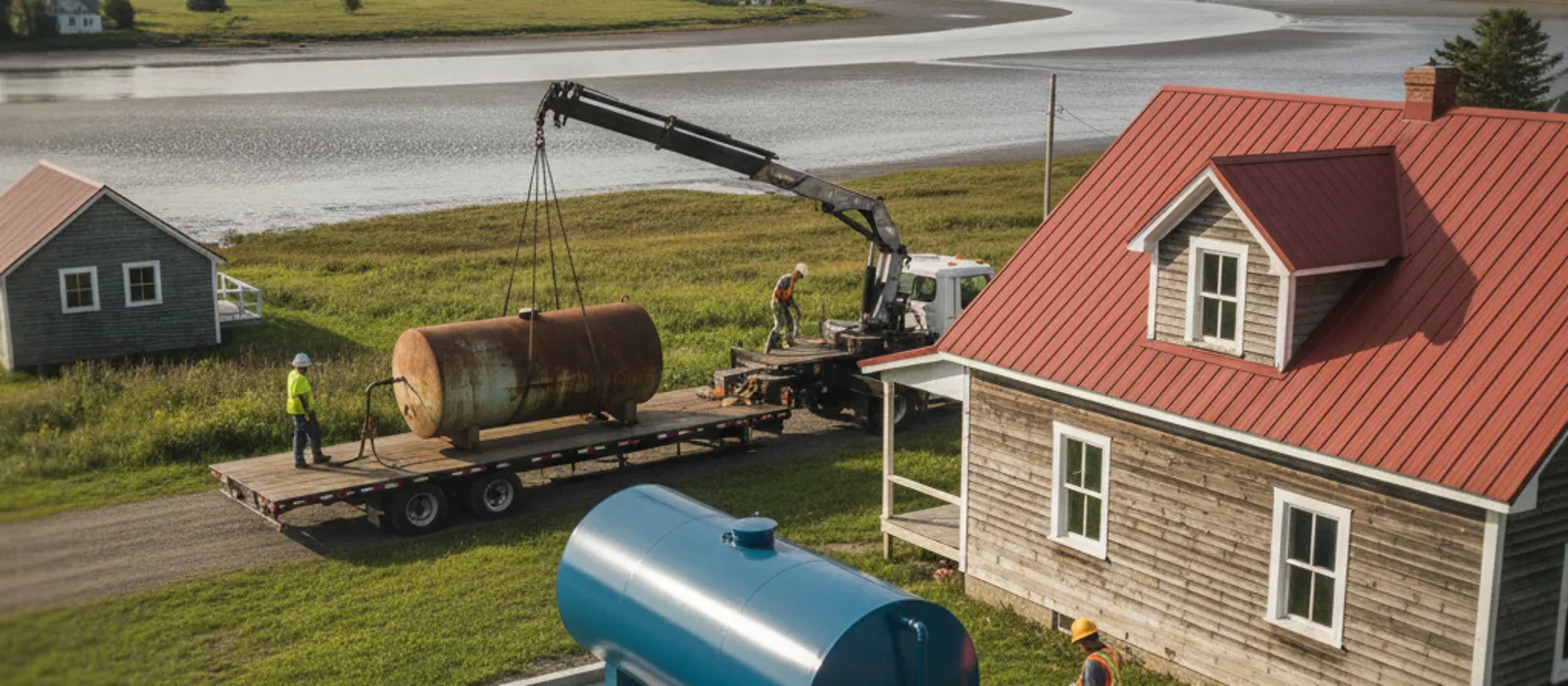
You’re planning a new deck, and your oil tank is sitting exactly where the stairs need to go. Or maybe your oil delivery driver just told you he can’t reach the fill pipe anymore because of the new fence. Whatever put the idea in your head, you’re now asking the same question we hear every spring in Greater Moncton: can you actually move this thing?
The short answer is yes, moving an oil tank is possible, and it’s done all the time. The longer answer is that it’s a fuel system job, not a furniture job. There are code rules about where the tank can go, real risks if it’s done wrong, and a surprisingly common situation where moving the tank costs almost as much as replacing it. This article walks through all of it, with real numbers from jobs around Moncton, Dieppe, Riverview, and out along the Shediac road.
If you’d rather just get a straight answer for your own yard, request a free written estimate or call us at (506) 806-0900. We’ll tell you honestly whether your tank is worth moving.
Why Homeowners End Up Moving an Oil Tank
Nobody wakes up wanting to relocate a 910 litre steel tank. Something forces the issue. Here are the reasons we see most often in Southeast New Brunswick.
Renovations top the list. Decks, additions, garages, and heat pump installs all compete for the same strip of wall where the tank usually lives. Snow and ice are a close second. A tank parked under the drip line of a metal roof takes a beating every winter, and a falling ice sheet can shear off a fill pipe or dent the tank shell.
Then there’s delivery access. Fuel trucks carry a long hose, but they can’t stretch it forever, and drivers won’t drag it over fences, through locked gates, or across skating-rink driveways. If the driver can’t reach the fill safely, you risk missed deliveries in January.
Insurance letters cause a lot of these calls too. Some insurers flag tanks that sit too close to a property line, a window, or a heat source, and they give you a deadline to fix it.
Marc in Shediac hit two of these at once last summer. His tank sat where his new garage slab needed to go, and it was catching salt spray off the road on top of that. We moved his 8-year-old tank about 5 metres to the sheltered side of the house, built a new patio stone base, and re-ran the fill, vent, and oil line. Total bill: $1,350. His tank was young enough and clean enough that moving it made complete sense.
Can You Legally Move an Oil Tank in New Brunswick?
Yes, but you can’t just put it anywhere, and you can’t just hire anyone. Oil tank installations in New Brunswick have to follow the CSA B139 installation code, and the fuel connection work needs to be done by a licensed technician. That’s not red tape for its own sake. The code exists because a heating oil release is one of the most expensive accidents a homeowner can have.
The code and good practice control things like:
- Base and support. The tank needs a stable, non-combustible base that won’t heave, tilt, or sink. Bare lawn doesn’t cut it.
- Clearances. There are rules about distance from appliances, ignition sources, and building openings, plus practical spacing from property lines that insurers care about.
- Fill and vent piping. The fill has to be reachable for the delivery driver, the vent needs its whistle working, and both have to terminate outside in an approved way.
- Protection. The tank should be protected from falling snow and ice, and from vehicles if it sits near a driveway.
- Oil line routing. A relocated tank almost always needs a new or extended oil supply line, and modern practice calls for protected, sleeved line.
Your insurance company also gets a vote. Most insurers want to know when a tank is moved or reinstalled, and many will ask for documentation from the installer. Skipping that paperwork can bite you hard later, because insurers can deny an oil leak claim on a tank that was moved off the books. We covered the wider rulebook in our guide to NB oil tank regulations.
For the environmental side of why the rules are strict, the New Brunswick Department of Environment and Local Government handles spill response in the province, and the federal government publishes standards for storage tank systems that shaped the codes we work under. One leaking residential tank can contaminate soil and groundwater and trigger a cleanup that runs into six figures.
What Moving an Oil Tank Actually Involves
Here’s the honest sequence for a typical outdoor tank relocation, so you know what you’re paying for.
1. Condition check first. Before anything gets disconnected, the tank has to earn the move. We check the age stamp, the bottom seam, the legs, and the paint for blistering or weeping. A tank that’s marginal where it sits will not get better by being tipped, dragged, and set down again. If you’re not sure how old yours is, the date is usually findable, and tank age matters more than anything else in this decision.
2. Pump out the oil. A 910 litre tank with even half a fill weighs several hundred kilograms and cannot be moved safely. The oil gets pumped into a transfer tank, and this is also where sludge shows up. Stirring up years of settled sludge and water is a real risk of relocation, and it’s why some furnaces act up right after a tank gets disturbed.
3. Disconnect and cap. The oil line, fill, and vent get disconnected and capped so nothing drips during the move.
4. Build the new base. Patio stones on compacted gravel, or a poured pad, sized and levelled for the tank and stand. This step decides whether your tank is still sitting straight in ten years.
5. Set, re-pipe, and reconnect. The tank goes on its stand, the fill and vent get re-run to the new location, and a new oil line gets routed and sleeved to the burner.
6. Leak check, bleed, and fire the burner. Every joint gets checked, the line gets bled of air, and the furnace or boiler gets run and confirmed before we leave.
Now the safety part, and we mean this. Moving the empty tank shell a short distance is muscle work, but everything on either side of that is fuel system work. Pumping oil, breaking fittings, running new line, and bleeding a burner are jobs for a licensed technician. We’ve been called to more than one basement that smelled like a fuel depot because a well-meaning homeowner cracked a flare fitting and “snugged it back up.” If you smell oil at any point, stop and call. Our emergency line at (506) 806-0900 answers 24/7.
Oil Tank Relocation Cost in Greater Moncton
Every yard is different, but here’s what relocation work typically runs in our service area. All prices are in Canadian dollars and assume a tank in good, moveable condition.
| Job | Typical cost (CAD) | What’s included |
|---|---|---|
| Short move, same wall, under 3 metres | $700 to $1,100 | Pump out, new base, reset, reconnect, restart |
| Move to a different side of the house | $1,100 to $1,800 | Above, plus new fill, vent, and oil line runs |
| Indoor tank moved to a new basement spot | $900 to $1,500 | Pump out, reset, re-pipe, careful spill protection |
| Indoor tank replaced with new outdoor tank | $3,500 to $6,400 | New tank, stand, pad, lines, old tank removal |
| Relocation that turns into replacement | $3,500 to $6,400 | New tank installed at the new spot, old tank gone |
A few things push jobs toward the high end. Long oil line runs, concrete work, tight access for equipment, and winter conditions all add cost. So does discovering mid-job that the tank bottom is thinner than anyone hoped.
Denise in Riverview is the cautionary tale we share most. She wanted her tank moved out from under her back stairs before a deck rebuild, and the relocation quote came in at $1,500. But her tank was 23 years old with rust freckles along the bottom seam. Moving it would have meant spending $1,500 to reinstall a tank her insurer was likely to flag within a couple of years anyway. She put that money toward a new tank instead, installed at the better spot from day one, for $3,800 all in. Two years later the deck is built and the insurance renewal was boring, which is exactly what you want.
If your math is heading the same direction, our oil tank replacement service in Moncton includes removal and disposal of the old tank, so you’re not paying for the move twice.
When Moving the Tank Isn’t Worth It
Here’s the honest filter we apply before quoting any relocation.
Age. If the tank is past 15 years, moving it is usually money down the drain. Steel tanks corrode from the inside out, insurers get twitchy about older tanks, and a reinstalled old tank doesn’t reset anyone’s clock. You’d be paying skilled-trade rates to relocate a liability.
Condition. Rust at the bottom seam, weeping around fittings, bent or corroded legs, or a strong sludge smell at pump-out are all signs the tank shouldn’t be handled more than necessary. A shell that’s marginal can fail during or shortly after a move, and then you’ve got a spill at your brand new location.
Paperwork. No installation record, no age plate, no insurer on file? Some insurance companies simply won’t accept a mystery tank that’s been moved, no matter how solid it looks.
The math. When a relocation quote passes about 40 percent of replacement cost on an older tank, replacement almost always wins. You get a new tank, a fresh warranty, a documented install at the right spot, and an insurer that’s happy.
Paul in Salisbury ran into the paperwork problem. He bought his place in 2023 with an undocumented indoor tank and wanted it moved to the other end of the basement during a reno. His insurer wouldn’t commit to covering the tank after a move because nobody could prove its age. He opted for a new outdoor double-wall tank at $4,400 installed, and we handled the old tank removal as part of the job. His words at the end: “Should’ve just done this first.”
Picking the Right New Spot for Your Tank
If you’re going to move a tank, or install a new one at a better location, choose the spot like you’ll live with it for 20 years. Because you will.
- Out of the drip line. Never under the edge of a roof that sheds snow and ice. In Moncton winters that’s not a maybe, it’s a when.
- Reachable for delivery. The driver needs a safe, short hose run from where the truck parks. Ask your fuel company how much hose their trucks carry before you commit to a back corner.
- On a proper base. A level, frost-resistant pad with a correct stand. A tank that starts leaning puts stress on the oil line and the bottom seam.
- Away from traffic. Not where a car, plow, or lawn tractor can clip it.
- Sheltered from salt if you’re coastal. In Shediac and along the strait, road spray and sea air chew through tank paint faster than people expect.
- Visible. You want to be able to see the gauge and spot a drip early, not hide the tank behind a shed.
One more thing worth knowing: a good chunk of “move my tank” calls turn into a bigger conversation, because the best new spot is sometimes inside the basement instead of out in the weather, or the other way around. Each option has trade-offs for lifespan, smell, and winter reliability, and we’ve laid those out in our comparison of indoor versus outdoor oil tanks.
Ready for a real number instead of a range? Get your free written estimate or call (506) 806-0900. We’ll look at the tank, the yard, and the paperwork, and tell you straight whether moving an oil tank makes sense at your place or whether that money belongs in a new tank at the right spot.
Frequently Asked Questions
Can I move my oil tank myself?
You can legally shift an empty, disconnected tank shell across your yard, but everything before and after that point is licensed fuel work. Pumping out oil, disconnecting lines, re-piping the fill and vent, and restarting the burner all need a licensed technician, and your insurer will want proof it was done properly. Given that the DIY portion is the cheapest part of the job anyway, there’s very little money to save and a lot to lose. If you smell oil at any point, stop and call a professional right away.
How much does it cost to move an oil tank in Moncton?
A straightforward short move of a healthy tank usually runs $700 to $1,500 in the Greater Moncton area. Moving a tank to a different side of the house, with new fill, vent, and oil line runs, typically lands between $1,100 and $1,800. If the tank is old enough that replacement makes more sense, a new tank installed at the new location generally runs $3,000 to $5,500 depending on the tank and the site.
Do I need a permit or an inspection to move an oil tank in New Brunswick?
The installation has to meet the CSA B139 code, the fuel connections must be done by a licensed technician, and your insurance company should be notified with documentation of the work. Requirements can vary by municipality and insurer, so check before the job starts rather than after. A reputable installer will handle the code side and give you the paperwork your insurer wants to see.
Can you move a tank that still has oil in it?
No, and you shouldn’t let anyone try. A partly full 910 litre tank weighs several hundred kilograms, the sloshing weight makes it dangerous to handle, and stressing a full tank risks a spill that can cost more to clean up than a whole new heating system. The oil gets pumped out first, the tank gets moved empty, and the fuel goes back in after the leak check. It also gives your technician a chance to spot water and sludge before they reach your burner.