
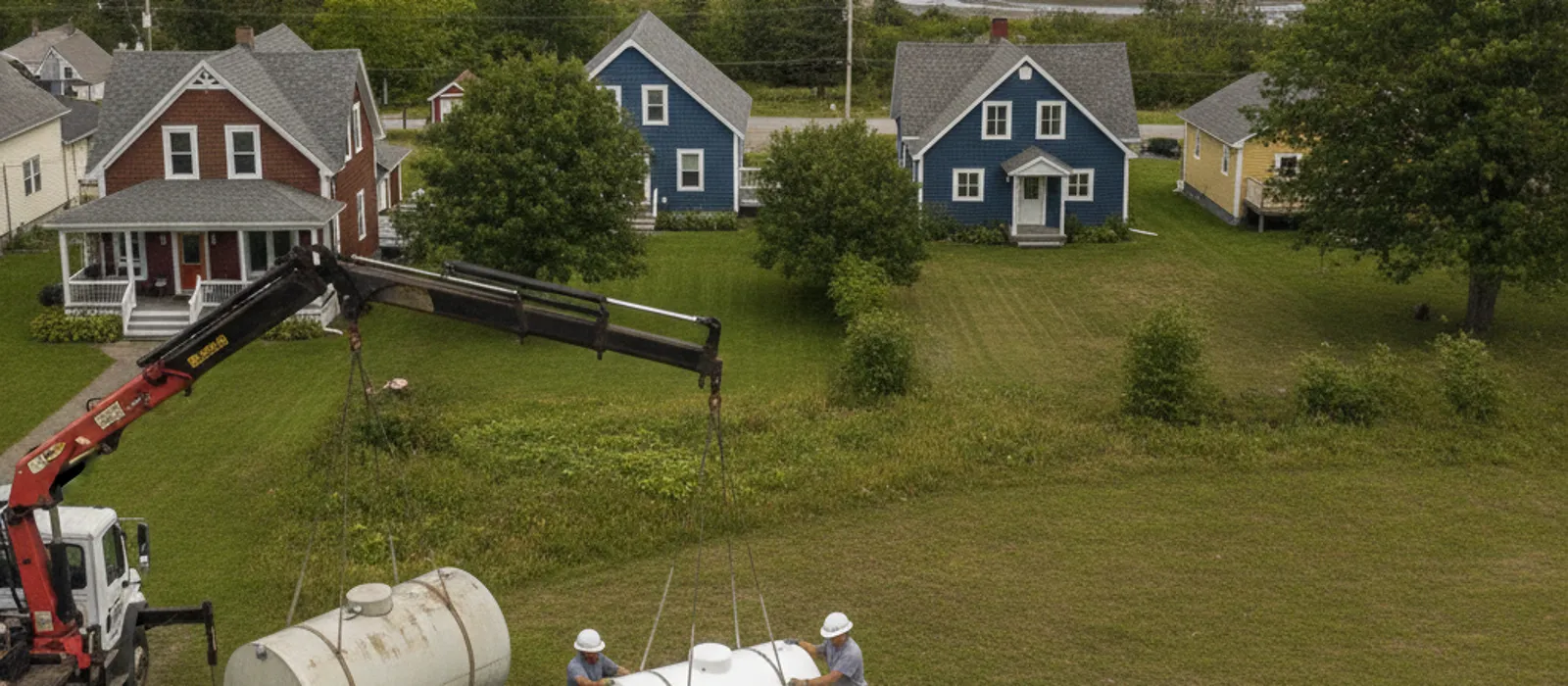
Here’s a number worth sitting with: a full 910 litre oil tank weighs close to 900 kilograms. That’s a small car parked on four steel legs in your side yard, all winter, through every freeze and thaw Moncton can throw at it. And yet most homeowners who worry about their tank never once look at what it’s standing on.
That’s backwards. A rusted oil tank stand or a heaved pad drops more tanks in Southeast New Brunswick than tank corrosion ever gets credit for. The tank can be two years old and spotless. If the base under it shifts, buckles, or sinks, the tank leans, the oil line strains, and sooner or later heating oil ends up on your lawn instead of in your furnace.
The good news? The base is the cheapest part of your whole heating system to fix, and the easiest to check. This guide covers what a proper stand and pad look like, why ours fail faster here than in most of Canada, and what the fixes actually cost in real dollars.
What an Oil Tank Stand Actually Does
An oil tank stand has one job with three parts: keep the tank level, keep it off the ground, and spread all that weight so the tank can’t sink or tip.
Level matters more than people think. Tanks are set with a slight, deliberate pitch so condensation inside collects where your technician expects to find it. When a base heaves, that pitch changes. Water can end up pooling along the bottom seam instead, and that’s exactly where tanks rust from the inside out.
Off the ground matters because soil holds moisture, and moisture eats steel. Legs resting on bare dirt or soggy wood wick water up into the tank’s feet year after year. By the time you see orange streaks, the steel underneath is thinner than you’d like.
And spreading the weight is the whole ballgame in our clay soils. Four small steel feet carrying 900 kilograms will punch into soft ground like a thumbtack into a corkboard. The tank doesn’t drop all at once. It settles a little each season until one day the lean is obvious from the street.
The Canadian installation code for oil systems, CSA B139, calls for a stable, non-combustible base for exactly these reasons. Insurance companies read that code closely. If your tank sits on bare ground or rotting timbers, an inspection can flag it, and some insurers won’t renew your policy until it’s corrected.
Not sure what your tank is sitting on right now? Call us at (506) 806-0900 and we’ll come take a look. The written estimate is free, and checking a base takes us about ten minutes.
Why Oil Tank Bases Fail Faster in Southeast New Brunswick
Three things gang up on tank bases around here: frost, clay, and salt.
Frost first. The ground in Greater Moncton freezes well below the depth of any patio stone. When wet soil freezes, it expands, and it doesn’t expand evenly. One corner of a pad lifts five millimetres, the opposite corner lifts fifteen, and now your tank has a twist in it. We don’t get one long freeze either. This area cycles above and below zero dozens of times each winter, and every cycle works the base a little looser.
Clay second. A lot of the soil in Moncton, Dieppe, and Riverview holds water like a sponge. It swells when it’s wet, shrinks when it’s dry, and gives frost plenty of moisture to work with. Patio stones laid straight on clay start moving the day they’re installed.
Salt third. Anywhere within reach of the Northumberland Strait, salt air speeds up rust on stand legs the way road salt eats truck frames. We’ve written before about what salt air does to oil tanks, and stands often take it worse than the tanks because nobody ever paints the underside of the legs.
Gary in Shediac learned that one the hard way last winter. His stand looked fine from the driveway. But the inside faces of the legs, the sides nobody looks at, had rusted deep, and one leg folded during a February thaw when the pad shifted under it. The tank ended up leaning against his foundation, still holding around 600 litres. We drained it, set a new precast pad and stand, and had him back in service for about $1,100. If that tank had gone all the way over, cleanup on a spill that size typically starts north of $15,000, and that’s before anyone talks about oil reaching the soil under the foundation.
Concrete Pads vs Patio Stones vs Steel Stands: What Actually Holds Up
There’s no mystery about what works in our climate. Here’s how the common setups compare.
| Base type | Typical installed cost (CAD) | Expected lifespan | Frost performance | Our verdict |
|---|---|---|---|---|
| Poured concrete pad on gravel | $600-$1,200 | 30+ years | Excellent | The gold standard |
| Precast concrete slab | $350-$700 | 20-30 years | Very good | Best value for most homes |
| Patio stones on compacted gravel | $150-$300 | 5-15 years | Fair, shifts with frost | Fine with a check every spring |
| Patio stones on bare soil | $50-$150 | 2-8 years | Poor | A lean waiting to happen |
| Wood timbers or blocks | $0-$100 | Until they rot | Poor | Fails code, fix it now |
A poured pad done right is 100 to 150 millimetres of reinforced concrete sitting on compacted gravel, extending past the tank’s footprint on every side. The gravel is what makes it work. It drains water away before frost can grab hold, so the pad floats through winter without twisting.
A precast slab is the workhorse choice. It goes in any month of the year, costs less than pouring, and handles frost well as long as it’s bedded on gravel rather than dropped on grass.
Patio stones aren’t automatically wrong. On a proper gravel base, with a solid welded stand on top, they can serve for years. But they move, so they need eyes on them every spring.
The stand matters too. A welded steel stand spreads load better than four loose legs, and the feet should sit fully on the pad with room to spare. A foot hanging half off the edge of a slab is carrying double the pressure it was designed for.
Warning Signs Your Oil Tank Stand or Pad Is Failing
You don’t need any training to catch most base problems early. Grab a small level and walk out to the tank. Here’s what you’re looking for:
- A visible lean, or a lean that’s grown since last year
- A gap under any leg, even a few millimetres, because that means three legs are carrying everything
- Flaking or scaling rust where the legs meet their feet
- Cracks running through the pad, or a pad edge sinking below the lawn
- Feet punching dimples into patio stones
- An oil line pulled taut or kinked where it leaves the tank
- Dark staining or an oily sheen on the ground after rain
If you can see the lean without a level, treat it as urgent. We covered why in our guide to leaning and sinking oil tanks, but the short version is that a lean almost never stops on its own. The load keeps shifting toward the low side, which loads that corner harder, which makes it sink faster.
Denise in Riverview caught hers early this spring. After the thaw, she spotted a two centimetre gap under one back leg and called us instead of shimming it with a chunk of wood, which is what her neighbour suggested. Good instinct. Shimming a full tank with scrap wood just concentrates all that weight onto whatever you wedged under there. We pumped the tank down, lifted it, bedded a new precast pad, and re-levelled everything for $520. Her tank had years left in it. The base was the only problem.
Rust on the legs deserves special mention because it hides. Steel scales from the inside corners of the angle iron and behind paint blisters, so a stand can look painted and solid while it’s losing strength. Our post on rust on oil tanks explains which rust is cosmetic and which is structural, and the same logic applies to stands.
Seeing a lean, a gap, or a wet spot right now? Reach us through the contact form or call (506) 806-0900. If there’s oil on the ground, use the same number, our emergency line is answered 24/7.
What a Proper Oil Tank Base Costs in Greater Moncton
Base work is honest money, and most of it costs less than people fear:
- Re-levelling a tank on an existing sound pad: $250 to $450
- New precast pad with the tank lifted and re-set: $450 to $800
- Poured reinforced pad, formed and cured, tank re-set: $700 to $1,300
- New steel stand or replacement legs: $200 to $450 on top of pad work
- Full tank replacement including a new pad and stand: usually $2,800 to $4,500
Timing matters. Nobody’s pouring concrete in a Moncton January, so if an insurance letter lands in late fall, a precast slab is usually the answer, with the option to pour something permanent in spring.
Paulette in Salisbury got one of those letters in October. She’d just bought the house, the tank sat on cedar timbers of unknown age, and her insurer gave her 30 days to fix the base or lose coverage. We set a precast pad and a new stand for $780 and sent the paperwork the same week. Her policy renewed without a hiccup. The seller’s home inspector had called those timbers “weathered but functional.” Timbers are never functional under 900 kilograms.
One caution before you spend on concrete: if the base has been bad for years, have the tank checked at the same time. A tank that’s spent seasons holding pooled water against its bottom seam may be closer to the end than it looks. That’s a judgment call we make on site, and if the tank’s done, our oil tank replacement service in Moncton folds the new pad into a single quote so you’re not paying for a site visit twice.
Simple Checks You Can Do, and When to Put the Level Down
Here’s a five minute routine worth doing every spring and every fall:
- Photograph the tank from the same two angles each time. A slow lean shows up in photos long before your eye catches it.
- Set a level on top of the tank and note where the bubble sits. Tanks carry a slight pitch by design, so what you’re watching for is change from season to season.
- Look at all four feet for gaps, rust scale, and dimpled stones.
- Follow the oil line with your eyes from tank to wall. It should have gentle slack, no strain.
- In winter, keep snow and roof ice from piling on the tank or sliding onto the line.
And here’s where DIY ends. Never jack, pry, or shim a tank that has fuel in it. Full stop. A loaded tank is heavier than a piano and far less forgiving, fittings can shear off, and a weakened leg can fold the moment the load shifts. If a leg has failed or the tank is moving, keep people and vehicles clear and make the call.
If oil is already on the ground, it’s a different phone call again. New Brunswick requires petroleum spills to be reported, and the province’s Department of Environment and Local Government treats releases seriously because cleanup costs climb the longer oil sits in soil. If you want a sense of how seriously regulators everywhere take stored oil, the U.S. EPA runs an entire spill prevention program for tanks just like these. Our emergency oil tank service covers leaking and fallen tanks anywhere in Westmorland, Albert, and Kent counties, day or night.
A sound base is the cheapest insurance your heating system will ever get. If you can’t remember the last time anyone looked under your tank, book a free written estimate or call (506) 806-0900 and we’ll tell you straight whether it needs work or just a photo every spring.
Frequently Asked Questions
Does my outdoor oil tank need a concrete pad in New Brunswick?
The governing installation code, CSA B139, requires a stable, non-combustible base, and in practice that means concrete, either poured or precast. Patio stones on a properly compacted gravel bed can pass, but they need a yearly check because frost moves them. Bare ground and wood timbers don’t cut it, and insurers increasingly refuse to cover tanks sitting on them.
How thick should a concrete pad be for an oil tank?
A poured pad should be roughly 100 to 150 millimetres thick, bedded on compacted gravel, and it should extend past the tank’s footprint on all sides. The gravel matters as much as the concrete because it drains water away before frost can heave the slab. A pad poured straight onto clay will crack and tilt no matter how thick it is.
Can I re-level a leaning oil tank myself?
Not with fuel in it, no. A full residential tank weighs close to 900 kilograms, and jacking or shimming it can shear a fitting or fold a weakened leg without warning. A professional will pump the tank down first, then lift and re-set it safely. Re-levelling is one of the cheaper jobs in this trade, usually a few hundred dollars, so it’s not worth the gamble.
Will insurance cover the damage if my tank falls off its stand?
Sometimes, but don’t count on it. Many home policies limit or exclude oil spill damage, especially if the insurer can show the base was visibly failing beforehand. That’s exactly why insurers send those inspection letters about tank age and bases. Read your policy closely, and remember that fixing a base for a few hundred dollars beats arguing over a five figure cleanup.